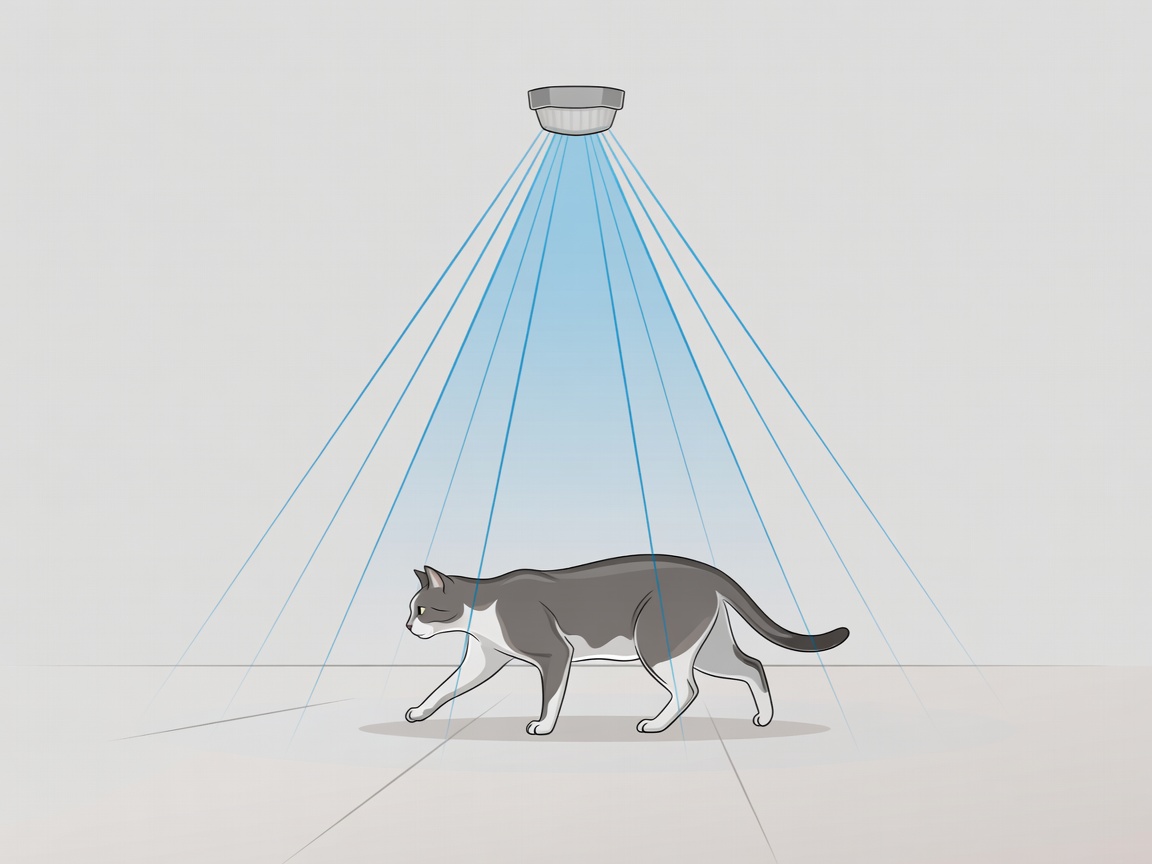
The Conflict Between Security and Pets
For decades, owning a large dog or an active cat meant compromising on interior security. Traditional motion sensors could not differentiate between a 60-pound burglar and a 60-pound Labrador Retriever; to the sensor, both represented a sudden change in infrared thermal energy moving across its field of view. The result was a choice between enduring constant false alarms or leaving the security system disarmed.
Modern pet-immune sensors solve this through a combination of tailored lens geometry, strict weight thresholds, and advanced signal processing, allowing homeowners to secure their properties without confining their animals.
How Pet Immunity Actually Works
A common misconception is that pet-immune sensors use AI or complex imaging to "recognize" a dog or cat. In reality, the technology relies heavily on physical lens design and spatial logic.
Most pet-immune PIR (Passive Infrared) sensors utilize a specialized Fresnel lens that deliberately ignores the lower volume of a room. When mounted at the correct height (usually between 7 and 7.5 feet), the lens projects its detection beams outward and slightly downward, but stops short of scanning the bottom 2 to 3 feet of the floor near the sensor. Since most pets navigate environments close to the ground, they pass underneath the detection beams entirely.
Additionally, the internal circuitry applies a weight threshold. The sensor is calibrated to ignore thermal mass below a specific size. If the total volume of infrared energy shifting across the lens segments does not cross this threshold, the alarm will not trigger.
Weight Threshold Categories
Manufacturers typically categorize their sensors into distinct weight classes. It is critical to select a sensor that comfortably exceeds the weight of your largest pet, or the combined weight of multiple pets if they tend to play or sleep closely together.
- Standard Immunity (Up to 40 lbs / 18 kg): Designed for small dogs and non-jumping cats. This is the most common residential specification.
- Heavy Immunity (Up to 80 lbs / 36 kg): Required for large breeds (e.g., German Shepherds, Retrievers). These sensors require larger movements and larger thermal signatures to trigger.
- Dual-Tech Immunity: Combines PIR with Microwave technology. The sensor verifies the target's mass via microwave reflection before triggering, providing the highest resistance to pet-induced false alarms.
The Feline Variable: Why Cats are Difficult
While dogs generally stay on the floor, cats are notorious for defeating pet-immune geometry. Because the sensor relies on ignoring the lower section of a room, a cat jumping onto a countertop, scaling a bookshelf, or traversing the back of a sofa will enter the active detection zone.
When placing a sensor in a home with cats, the installer must ensure the sensor does not face any tall furniture or staircases. The sensor must look out over an open space where the cat cannot elevate itself into the detection beams. If this is impossible due to room layout, window or door contact sensors may be a more reliable security alternative than motion detection for that specific zone.
Testing and Calibration
Never assume a pet-immune sensor will work flawlessly out of the box. Following installation, the system should be placed in "test mode." The homeowner should allow their pets to roam freely for several days to ensure their typical behaviors do not trigger the device. If false alarms occur, the installer may need to adjust the mounting height slightly or reduce the sensitivity via internal jumpers or software settings.